

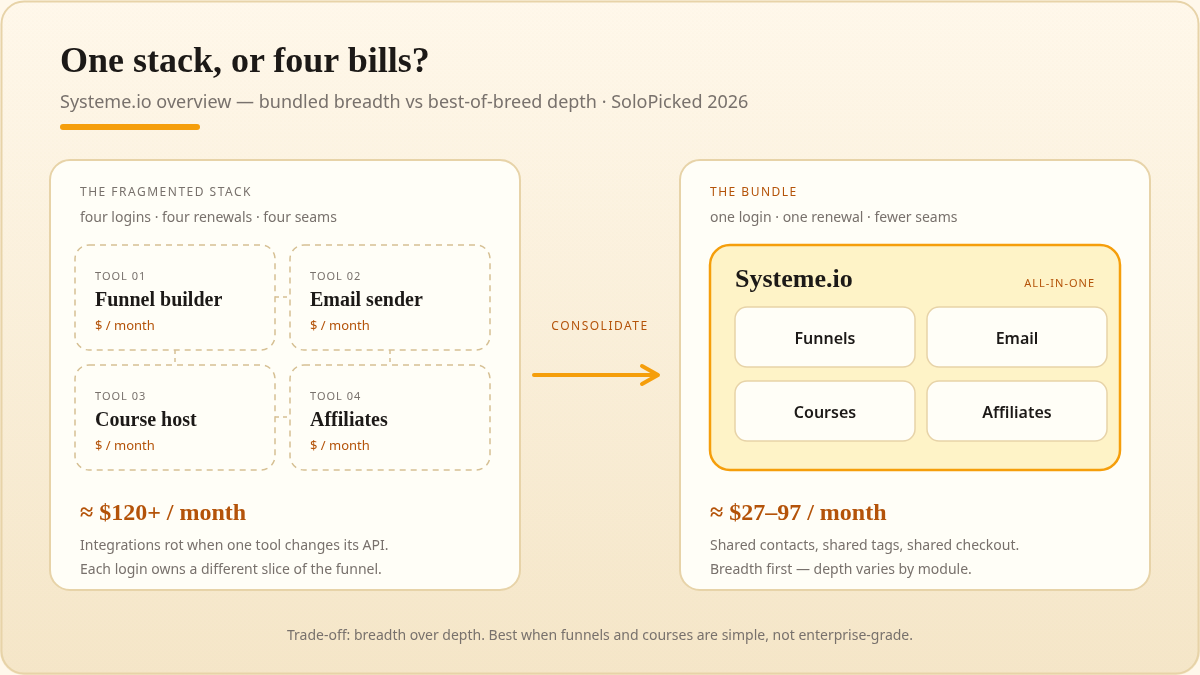
Systeme.io is one of the better-known “all-in-one” platforms for solopreneurs, creators, and small digital-product businesses. It combines sales funnels, email marketing, online courses, memberships, blogs, and automation in one subscription. That combination is attractive if you are tired of stitching together a funnel builder, an email service provider, a course platform, and a blog.
This review is editorial research, not a hands-on lab test. We did not run a personal 90-day experiment, and we are not presenting fabricated usage claims. Our analysis is based on Systeme.io’s public documentation, pricing page, help center, and publicly available comparisons. Pricing and feature limits change, so treat the numbers here as directional and verify current details before you buy.
Affiliate disclosure: Some links on SoloPicked may be affiliate links. If you purchase through them, we may earn a commission at no extra cost to you. Read our full affiliate disclosure.
CTA: Try Systeme.io →
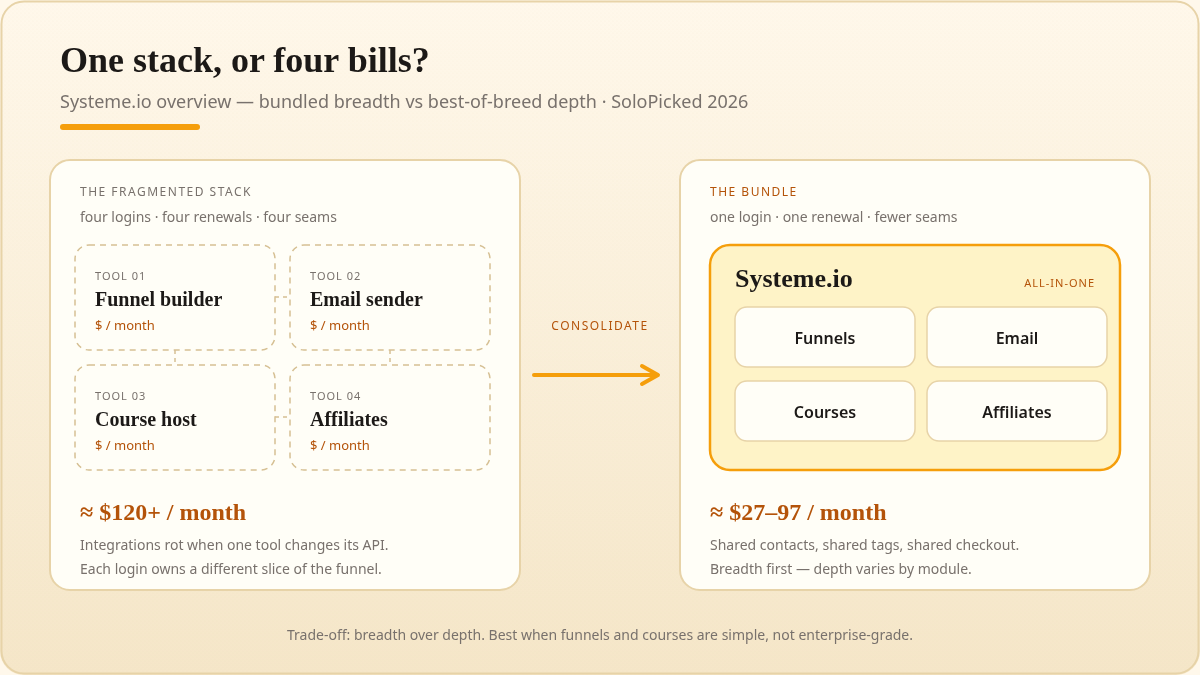
Illustrated chart (warm amber / cream). Not vendor UI.
Quick verdict: who is Systeme.io for?
Systeme.io is best suited to a specific kind of buyer: a solo operator who wants one login, one bill, and a reasonably simple path from lead capture to email follow-up to a paid offer. It is especially relevant if your funnel and course needs are straightforward and you value bundled functionality over best-in-class design or advanced marketing sophistication.
It is not the obvious choice for every creator. If email deliverability, advanced segmentation, complex automation, or premium course production is the center of your business, a dedicated tool may serve you better. Systeme.io’s pitch is convenience and breadth, not necessarily depth in every category.
| Buyer profile | Fit with Systeme.io |
|---|---|
| Solopreneur launching a first digital product | Strong |
| Creator selling a course plus email follow-up | Strong to moderate |
| Funnel-first marketer who wants built-in email | Strong |
| Blogger who mainly needs WordPress-level publishing | Weak to moderate |
| Advanced email marketer with complex automation | Moderate to weak |
| Premium course brand needing high-end experience | Moderate |
| Team needing deep roles, reporting, and workflows | Weak to moderate |
What is Systeme.io?
Systeme.io is a SaaS platform marketed as an all-in-one business tool for online entrepreneurs. Its core promise is that you can build landing pages and sales funnels, collect leads, send emails, sell courses, run memberships, publish a blog, and automate follow-up without needing separate subscriptions for each function.
The platform is positioned toward the lower-to-mid end of the all-in-one market. It is often compared with tools like Kajabi, Podia, Teachable, Kit, and other creator platforms, but Systeme.io’s identity is more funnel-centric. The funnel builder is not just an add-on; it is one of the main reasons people choose the platform.
From public documentation, the product’s main building blocks are:
- Sales funnels and landing pages
- Email campaigns and newsletters
- Online courses and memberships
- A built-in blog
- Rule-based automation
- Contact and tag management
- Order forms, upsells, and basic checkout flows
That breadth is the key selling point. Instead of paying for a funnel tool, an email tool, and a course tool separately, you can consolidate into one account. The trade-off is that each module may not be as deep as a specialist product.
Core modules: what you actually get
1. Sales funnels and landing pages
Systeme.io’s funnel builder is the center of the product. Public docs describe a visual approach to creating funnel pages, opt-in forms, sales pages, order forms, upsells, and thank-you pages. You can publish pages on Systeme.io’s hosting and connect a custom domain.
For a solopreneur, this is useful because the funnel is connected directly to contacts, tags, email campaigns, and course access. You do not need to integrate a separate page builder with an email platform just to launch a lead magnet and a paid offer.
The caveat is design flexibility. Systeme.io is generally regarded as functional rather than elite for pixel-perfect, brand-heavy page design. If you need highly customized layouts, advanced animations, or a large template ecosystem, a dedicated page builder may feel more flexible. For simple lead-generation and sales funnels, the built-in tools are usually enough.
CTA: Try Systeme.io →
2. Email marketing
Systeme.io includes email campaigns, newsletters, contact management, tags, and automation rules. The email module is tightly connected to funnels and courses, which is the main advantage. When someone opts in, buys, or joins a course, you can trigger tags and follow-up sequences inside the same platform.
This makes Systeme.io attractive for creators who want a straightforward “capture lead, send sequence, pitch offer” workflow. You can manage subscribers and send broadcasts without leaving the dashboard.
However, advanced email marketers should look closely at the limits. Dedicated email platforms often provide more mature segmentation, deliverability tooling, template libraries, and complex automation. Systeme.io’s email features are practical, but they are not the main reason an advanced email operator would switch. The email module is best understood as “good enough and tightly integrated,” not “best-in-class.”
3. Courses and memberships
Systeme.io supports online courses and membership sites. Based on public help-center documentation, you can create course content, organize lessons or modules, and grant access after purchase. This is a major reason creators consider the platform: it lets you sell a course and deliver it without adding a separate course platform.
For a first course, a low-ticket digital product, or a simple membership, this is a sensible setup. The value is in the integration. A buyer can purchase through a Systeme.io funnel and receive course access without a complicated third-party connection.
For premium course businesses, the calculation is different. Kajabi and similar platforms are often stronger for polished course experiences, advanced marketing around courses, and a more premium brand feel. Systeme.io is capable, but it is not automatically the best choice for a high-ticket coaching or course brand that needs a highly refined learner experience.
4. Blogs
Systeme.io includes a blog feature, which is useful if you want basic content publishing inside the same platform as your funnels and email. You can publish posts and keep your content under the same domain as your offers.
That said, the blog is not a replacement for WordPress in most content-heavy operations. If your business depends on a large editorial library, advanced SEO plugins, complex content workflows, or a deep plugin ecosystem, WordPress or a dedicated blogging platform will usually be more flexible. Systeme.io’s blog is best for creators who want a lightweight content presence alongside their funnels—not for professional publishers.
5. Automation
Systeme.io offers automation rules that can respond to events such as form submissions, purchases, tags, and course activity. This is the glue that makes the all-in-one promise useful. For example, you can tag a new lead, trigger an email sequence, and grant access to a course after purchase.
The automation is rule-based and approachable. It is not necessarily the same as a fully visual, enterprise-grade workflow builder. Solopreneurs with simple logic will likely find it sufficient. Marketers with complex branching, advanced lead scoring, or multi-system workflows should compare carefully with dedicated automation tools.
Pricing overview
For a dedicated breakdown of plan signals and who should upgrade, see Systeme.io pricing explained.
Systeme.io is known for having a free plan and a tiered subscription model. At the time of this editorial research, the publicly advertised structure generally follows this pattern:
| Plan | Approximate monthly price | Typical positioning | Important caveat |
|---|---|---|---|
| Free | $0 | Test the platform and launch a small setup | Contact, funnel, and feature limits apply |
| Startup | Around $27/month | First paid tier for active solopreneurs | Limits increase, but you may outgrow it |
| Webinar | Around $47/month | More contacts and funnel capacity | Confirm current webinar and automation limits |
| Unlimited | Around $97/month | Highest published tier for broader usage | “Unlimited” is subject to fair-use and published limits |
Pricing caveat: These figures are approximate and can change. Annual billing may reduce the effective monthly price, taxes may apply, and feature limits vary by plan. Do not rely on this table as a quote. Check Systeme.io’s official pricing page for current numbers before purchasing.
The strategic point is that Systeme.io’s entry price is low relative to many all-in-one competitors. The free plan lowers the barrier to testing. The paid tiers are still generally affordable for a solo operator. The risk is not usually a surprise enterprise bill; it is that you may need to move up a tier as your contact list and funnel usage grow.
Pros of Systeme.io
- Strong value for the bundle. You get funnels, email, courses, memberships, blogs, and automation in one subscription. For a solo operator, that can replace multiple tools.
- Low barrier to entry. The free plan makes it possible to evaluate the platform without a major commitment.
- Funnel-first workflow. The platform is built around moving a lead from opt-in to offer, which fits many digital-product businesses.
- Tight integration between modules. Tags, purchases, email, and course access can live in one system, reducing integration friction.
- Simple enough for non-technical users. Public documentation suggests a reasonably approachable interface for solopreneurs who do not want a complex tech stack.
- Good fit for first launches. If you are validating an offer, a lead magnet, or a small course, Systeme.io can cover the core pieces without a patchwork setup.
Cons of Systeme.io
- Not best-in-class in every module. The all-in-one promise means trade-offs. The funnel builder, email system, blog, and course experience are each competent, but specialists may outperform them in depth.
- Design flexibility has limits. If you need highly customized pages or a premium brand experience, you may feel constrained.
- Email marketing is practical, not advanced. Complex segmentation and sophisticated automation may push you toward a dedicated email platform.
- Blog is lightweight. Content-heavy publishers should not assume it replaces WordPress.
- Reporting and analytics may feel basic. Solo users may not care, but data-driven operators should check whether the reporting meets their needs.
- Ecosystem and support depth. Larger platforms often have bigger template ecosystems, agencies, and community resources. Systeme.io’s ecosystem is meaningful but smaller than the most established competitors.
- Upgrade pressure as you grow. Contact limits and funnel limits can push you to higher tiers, so the cheapest plan may not remain the cheapest over time.
Systeme.io alternatives
| Alternative | Best for | How it compares |
|---|---|---|
| Kit (formerly ConvertKit) | Email-first creators, newsletters, and creator commerce | Stronger email-centric workflow and creator audience; less of a native all-in-one funnel and course platform |
| Kajabi | Premium courses, coaching, and polished creator businesses | More mature premium course and marketing experience; usually higher cost |
| Podia | Simple course and digital product sales | Easier, cleaner storefront feel; less funnel-centric than Systeme.io |
| Teachable | Course-focused businesses | Strong course delivery and learning experience; may require additional tools for funnels and email |
| WordPress plus plugins | Content-heavy blogs and custom sites | Maximum flexibility and SEO control; more maintenance and integration work |
The comparison is not “which tool is best overall.” It is “which tool fits your bottleneck.” If your bottleneck is email, Kit deserves a look. If your bottleneck is a premium course experience, Kajabi-level platforms deserve a look. If your bottleneck is launching a simple funnel, course, and email sequence from one dashboard at a low entry price, Systeme.io is a credible option.
Verdict: is Systeme.io worth it in 2026?
Systeme.io is worth considering if you are a solopreneur or creator who wants a practical all-in-one stack without paying premium prices. Its strongest argument is consolidation: funnels, email, courses, memberships, blogs, and automation in one place. For a first digital product, a lead-generation funnel, or a simple course business, that can be enough.
It is less compelling if you need specialist-level email marketing, a premium course experience, a content-heavy blog, or highly customized design. In those cases, the all-in-one convenience may become a constraint. Systeme.io is not a shortcut to best-in-class everything; it is a shortcut to a workable integrated setup.
Our editorial verdict: Systeme.io is worth it for the right buyer, not for every buyer. It is a strong value play for simple funnel-and-course businesses. It is a weaker fit for advanced marketers and premium course brands. Before committing, map your must-have features against the current plan limits, especially contacts, funnels, courses, and automation.
CTA: Try Systeme.io →
FAQ
Is Systeme.io really free?
Systeme.io has historically offered a free plan, but it comes with limits on contacts, funnels, and features. It is best treated as a testing or starter plan, not a guarantee that you can run a full business forever without paying. Check the current free-plan limits before relying on it.
Can I use Systeme.io for email marketing?
Yes. Systeme.io includes email campaigns, newsletters, contact management, tags, and automation rules. It is a practical option for simple follow-up sequences tied to funnels and courses. Advanced email marketers should compare segmentation, deliverability, and automation depth with dedicated email platforms.
Does Systeme.io host online courses?
Yes. Systeme.io supports courses and memberships, and public documentation describes creating and delivering course content inside the platform. It is a good fit for straightforward course delivery, especially when paired with a Systeme.io funnel and checkout.
Is Systeme.io good for bloggers?
It can work for a lightweight blog attached to a funnel-based business. It is not the best choice for a large content operation that depends on WordPress-level SEO plugins, complex editorial workflows, or a deep plugin ecosystem. Think “supporting blog,” not “professional publishing platform.”
Can I migrate my email list and funnels to Systeme.io?
Migration is possible in many cases, but the process depends on what you are moving and which tools you use. Contacts and tags are usually the easiest part; funnel pages, automations, and course content may require manual rebuilding. Plan for cleanup and testing rather than assuming a one-click transfer.
Is Systeme.io better than Kajabi?
It depends on your priorities. Systeme.io is generally more affordable and funnel-centric. Kajabi is generally stronger for premium course and coaching businesses that want a polished creator platform. If price and consolidation matter most, Systeme.io may win. If premium course experience matters most, compare Kajabi-level platforms carefully.
Who should not use Systeme.io?
You should be cautious if you need advanced email segmentation, enterprise-level automation, a highly customized design system, a content-heavy WordPress blog, or a premium course experience with extensive branding. In those cases, a specialist stack may be worth the extra cost and integration work.
Final take
Systeme.io’s appeal is straightforward: one platform, one bill, and a clear path from lead capture to email follow-up to paid offer. That is a real advantage for solopreneurs who do not want to become an integration specialist just to launch a digital product.
The platform is not flawless. Its modules are practical rather than dominant, and growing businesses may eventually need more depth. But for the right stage and the right business model, Systeme.io can be a sensible, cost-conscious choice in 2026.
If you want to evaluate it yourself, start with the current free or entry plan, confirm the limits, and map your funnel, email, and course needs before upgrading.
CTA: Try Systeme.io →