

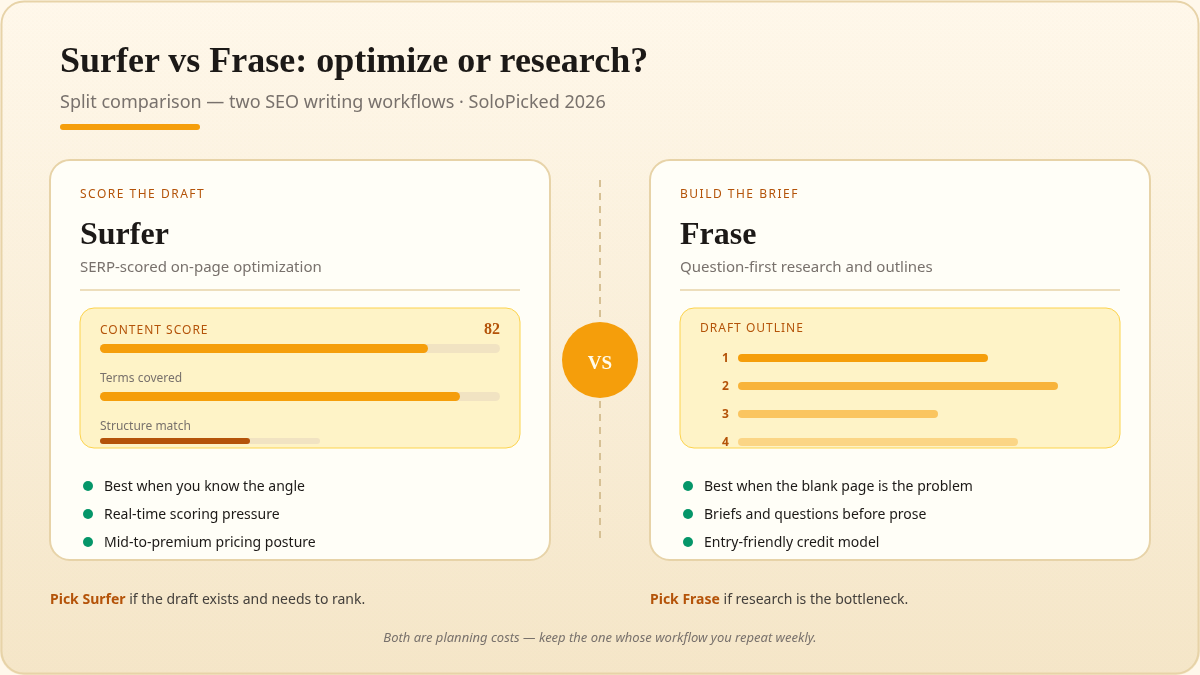
If you publish content for a living — or you're trying to — you've probably noticed that the "SEO writing tool" category has quietly split into two philosophies. One camp treats ranking as an optimization problem: score the draft against the SERP, hit the terms, ship. The other treats it as a research problem: understand the questions, outline the answer, then write.
Surfer and Frase sit on opposite ends of that spectrum, even though their marketing pages sound similar. This comparison is research-based — we looked at published documentation, vendor pricing pages, changelogs, and aggregated user feedback rather than running a timed head-to-head test. The goal is to help you pick the tool whose workflow matches how you actually write, because that's the variable that determines whether you'll still be using it in six months.
Affiliate disclosure: Some links on this page are affiliate links. If you subscribe through them, SoloPicked may earn a commission at no additional cost to you. That never changes our scoring or recommendations. Read the full affiliate disclosure.
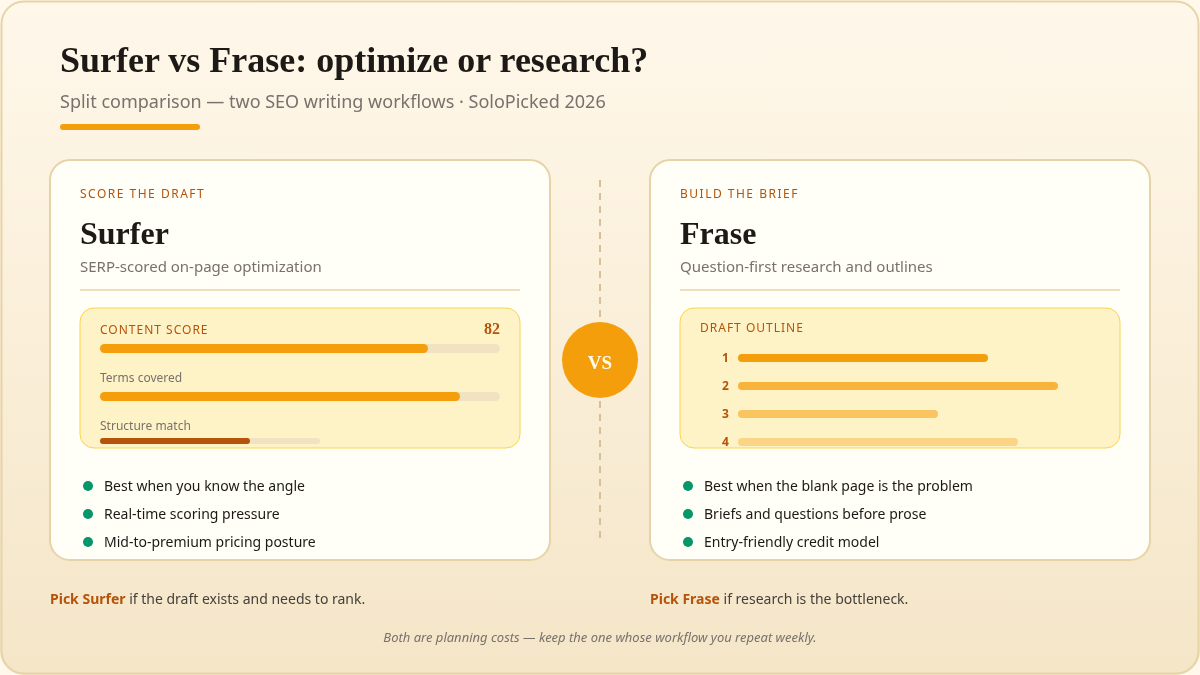
Illustrated chart (warm amber / cream). Not vendor UI.
Quick verdict: Surfer vs Frase at a glance
| Dimension | Surfer | Frase |
|---|---|---|
| Core strength | On-page optimization scoring and SERP-driven content structure | Research, briefs, and question-based outlining |
| Best for | Creators who already know what to write and want to rank it | Creators who struggle with what to write and how to structure it |
| Content editor | Mature, real-time scoring with detailed term guidance | Solid optimizer, historically less granular than Surfer |
| Briefs | Generated from SERP analysis, decent but secondary | The product's centerpiece — detailed, question-rich briefs |
| AI writing | Surfer AI article generation + in-editor assist | Frase AI writer built around briefs and outlines |
| Learning curve | Moderate; the scoring panel can overwhelm new users | Lower for research; moderate for optimization |
| Typical fit | Solo blogger, niche site builder, content-led SaaS founder | Newsletter writer, agency-of-one, consultant producing client content |
| Pricing posture | Mid-to-premium, tiers gated by article/credit limits | Historically entry-friendly, with credits gating AI usage |
Short version: Surfer is the better finishing tool. Frase is the better starting tool. If you write a lot and your bottleneck is "will this draft rank," Surfer earns its price. If your bottleneck is "I don't know what to cover," Frase's brief workflow will save you more time per article.
Check Surfer's current plans →
What each tool actually is
Surfer in one paragraph
Surfer began as a content editor that scored drafts against the top-ranking pages for a keyword. That core — the Content Editor with its real-time score, term list, and structure suggestions — is still what most people subscribe for. Around it, Surfer has built a SERP Analyzer, a content audit tool for existing pages, and a topical-map feature for planning clusters. Surfer AI can generate full article drafts, and the editor includes AI assists for outlining and rewriting sections. The implied promise is: bring a draft, leave with something structurally competitive.
Frase in one paragraph
Frase started from the other direction: research and briefs. You enter a keyword, and Frase pulls the SERP, extracts headings, surfaces related questions (often from People Also Ask and similar sources), and assembles a brief you can hand to a writer — or to yourself. The AI writer generates drafts from that brief. Frase has since added on-page optimization scoring, so the gap with Surfer has narrowed, but the center of gravity is still the brief. The implied promise is: bring a keyword, leave with a plan.
That difference in center of gravity explains almost every downstream trade-off in this comparison.
Feature comparison
| Feature | Surfer | Frase | Who cares |
|---|---|---|---|
| SERP analysis | Strong; detailed competitor breakdown, word counts, heading structures | Present; oriented toward extracting questions and outline elements | Both matter, but Surfer's is more diagnostic |
| Content editor scoring | Real-time, granular, term-level guidance | Available; less detailed term-by-term feedback in most reports | Surfer |
| Brief generation | Good, SERP-driven | Excellent, question-rich, the flagship feature | Frase |
| AI draft generation | Surfer AI, credit-metered | Frase AI writer, credit-metered | Depends on volume |
| Question / PAA research | Available but not the emphasis | Core strength | Frase |
| Topical clusters / maps | Topical Map feature | Topic-focused research, less map-centric | Surfer |
| Content audit | Yes, for existing pages | Limited compared with Surfer | Surfer |
| Google Docs integration | Yes | Yes | Both |
| WordPress publishing | Yes | Yes | Both |
| Team collaboration | Yes, multi-seat tiers | Yes, multi-seat tiers | Both, at higher plans |
| Free tier / trial | Limited trial signals; historically short | Free plan historically available with caps | Frase for trying before buying |
A note on that last row: free plans and trial lengths are the single most volatile thing on any SaaS pricing page. Vendors change them quarterly. Treat any specific number you read — including in this post — as a snapshot, not a contract.
Optimization scoring: Surfer's home turf
Surfer's editor gives you a numeric score that moves as you type. Underneath it, you get a term list with recommended counts, word-count ranges derived from competitors, heading suggestions, and flags for missing structure. The value isn't the number itself — it's the friction. You see "you haven't mentioned X" and you decide whether X belongs in the piece.
The practical benefit for creators is speed of revision. If you already write competent drafts, Surfer compresses the "did I miss anything obvious" pass from twenty minutes of SERP-skimming into a two-minute scan.
The practical cost is over-fitting. Because the score is visible and rewarding, it's easy to start writing for the panel instead of the reader. The published guidance from most experienced users converges on the same advice: aim for a competitive band, not a perfect score, and never add a term that makes the sentence worse.
Frase's optimizer covers similar ground — term coverage, competitor comparison, structural checks — but most comparative write-ups describe it as less granular at the term level. That's a real difference if optimization is your primary reason for subscribing, and a minor one if you mainly want briefs.
Pick Surfer for scoring if: you publish consistently, you have a defined niche, and your problem is that good drafts underperform.
Briefs and research: Frase's home turf
Frase's brief builder is the reason a lot of writers stay with it. Enter a keyword, and you get a document containing competitor headings, related questions, topic-relevant terms, and often a suggested outline you can edit. The question extraction is the standout: it consistently surfaces the "people also ask" style queries that make a piece feel complete rather than thin.
For a solo creator, this maps to a specific and common failure mode: you write 1,500 words on a topic and miss the three sub-questions that most of the audience actually searched. Frase front-loads those questions so they end up in your H2s instead of in the comments.
Surfer's brief generation is competent and SERP-derived, but most users describe it as a supporting feature rather than the reason they bought. If briefs are the deliverable you care about — for yourself or for a freelance writer you hand off to — Frase is the more purpose-built tool.
The trade-off is that research tools can encourage outline sprawl. A Frase brief with forty suggested questions is not a mandate to answer all forty. The discipline is choosing the five that a single reader actually needs answered in one sitting.
Pick Frase for research if: you frequently stall at the outlining stage, or you produce content for multiple clients and need repeatable briefs.
AI writing assist
Both tools ship AI drafting, and both meter it with credits rather than unlimited use. The difference is architectural.
Surfer AI generates a full article from a keyword and target settings, then you refine it in the editor with the score visible. The output tends to be structurally optimized from the first paragraph, which is either efficient or formulaic depending on your standards.
Frase AI writes from the brief. Because the brief already contains the questions and outline, the generated draft inherits that research and usually covers more sub-topics out of the box. It also means the quality of the output is bounded by the quality of the brief you edited.
Two caveats apply equally to both:
- Credits are the real pricing variable. The headline monthly price tells you almost nothing about cost per article. Check how many AI articles your tier includes and what overage costs.
- AI drafts are starting points, not deliverables. Neither tool's output survives contact with a discerning reader without a human pass. If you publish AI drafts unedited at scale, the ranking benefit is temporary and the brand cost isn't.
Pricing caveats before you commit
We deliberately aren't quoting exact dollar figures here, because both vendors revise tiers and credit allowances frequently and a stale number is worse than no number. What's stable enough to plan around:
- Both price by tier, and both gate AI usage by credits. The cheapest tier that "includes AI" may include very few articles per month.
- Annual billing discounts are significant — often in the 20–30% range historically — but they also lock you into a tool you may not have validated yet. Monthly first, annual after two months of real use.
- Seat limits matter more than you think. Solo plans often restrict collaboration, and the jump to the next tier is steep for a one-person operation.
- Surfer tends to sit higher on the entry price ladder. The value case depends on how many articles per month you actually optimize. At two articles a month, the per-article cost is hard to justify; at eight, it's easy.
- Frase's entry point has historically been lower, which makes it the lower-risk experiment if you're unsure whether you need either tool.
- Watch for feature-tier gating. Content audits, topical maps, and API access are commonly reserved for upper tiers. If a specific feature is your reason for buying, verify it's on the plan you're considering.
Before subscribing to either, run the same test: take one keyword you actually want to rank for, and complete a full article inside the trial. If the workflow feels like extra steps rather than fewer, the tool is wrong for you regardless of price.
Check Surfer's current plans →
Workflow: how each fits a solo creator's week
The Surfer workflow
- Pick the keyword from your existing plan or keyword tool.
- Run the SERP Analyzer to see what the top pages look like — word counts, headings, coverage.
- Write the draft wherever you're comfortable (Google Docs, the editor, your CMS).
- Open the Content Editor, paste or sync the draft, and work the score into a competitive band.
- Add internal links and a real conclusion — the two things the score can't judge.
- Publish and audit later using Surfer's content audit to catch pages that have drifted.
This workflow assumes you arrive with a topic. Its strength is the feedback loop: write, measure, revise, ship. Its weakness is that the measurement can become the goal.
The Frase workflow
- Enter a keyword and let Frase assemble the SERP snapshot and question set.
- Build the brief — cut the suggested questions down to the ones worth answering, reorder headings, add your angle.
- Write from the brief, or generate a draft and rewrite it in your own voice.
- Run the optimizer for a term and structure pass.
- Publish, then reuse the brief as a template for adjacent topics.
This workflow assumes you arrive with a keyword and a blank page. Its strength is that you never start from zero. Its weakness is that a rich brief can substitute for thinking if you let it.
A hybrid that works for solo operators
A pattern that shows up repeatedly in creator communities: use Frase (or any research-first tool) to build the brief, write in Google Docs, then do the final optimization pass in Surfer. It's the best of both, and it's also two subscriptions. For most solo creators, running both costs more than the marginal gain — pick the bottleneck that actually slows you down and solve that one first.
Which should you pick?
Choose Surfer if:
- You already have a content backlog and the problem is performance, not ideation.
- You write in a defined niche where term coverage is genuinely predictive of ranking.
- You want content audits and topical planning in the same subscription.
- Your publishing cadence is high enough that per-article cost is trivial.
Choose Frase if:
- You stall at the outline stage more often than at the revision stage.
- You produce briefs for other writers, even occasionally.
- You want a lower-cost entry point before committing to a content tool stack.
- Question-based research is central to your niche (how-to, health, finance, anything where intent is fragmented).
Choose neither, for now, if:
- You publish fewer than two articles a month. A spreadsheet and a careful read of the top five results will get you most of the way.
- You haven't yet validated that content is your growth channel. Tools optimize an existing motion; they don't create one.
FAQ
Is Surfer better than Frase overall? No single answer — they optimize different stages. Surfer is stronger at on-page scoring and content audits; Frase is stronger at research and briefs. "Better" depends on which stage is your bottleneck.
Can I use Frase and Surfer together? Yes, and some creators do: brief in Frase, optimize in Surfer. The cost is two subscriptions, which only makes sense if you're publishing enough volume to justify both.
Which is cheaper for a solo blogger? Historically Frase has had the lower entry point, but both vendors change tiers and credit allowances often. Compare the plan that includes the AI credits you actually need, not the headline cheapest plan.
Do I need an SEO writing tool at all? If you publish consistently and want to compete for competitive keywords, yes — the research compression alone is worth it. If you publish occasionally, manual SERP analysis is sufficient and free.
How accurate are the content scores? Treat them as directional. They measure term and structure overlap with ranking pages, not whether your article is good. A high score on a boring article still loses to a lower score on a useful one.
Do these tools work for non-English content? Both support multiple languages, but term-level scoring quality varies by language and by how much data the vendor has for that SERP. Test with one article in your target language before committing annually.
What about the AI detection / humanization question? Both vendors have shipped features aimed at making AI output read more naturally. Treat these as editing aids, not compliance guarantees. The reliable path is still a human rewrite of any AI-generated draft.
Final take
The honest framing is that Surfer and Frase are less competitors than they are two halves of a workflow. Surfer answers "is this draft competitive?" Frase answers "what should this draft contain?" Most solo creators only have one of those problems at a time — and the tool that solves your current problem is the one worth paying for.
If you're optimizing existing content and publishing on a schedule, start with Surfer. If you're staring at a blank page more often than a low-ranking one, start with Frase. Either way, run a real article through the trial before you commit to an annual plan.
Pricing, plan limits, and feature availability referenced in this post reflect published vendor information and aggregated user reports at the time of writing. Verify current details on each vendor's pricing page before purchasing. See our affiliate disclosure for how SoloPicked is funded.