

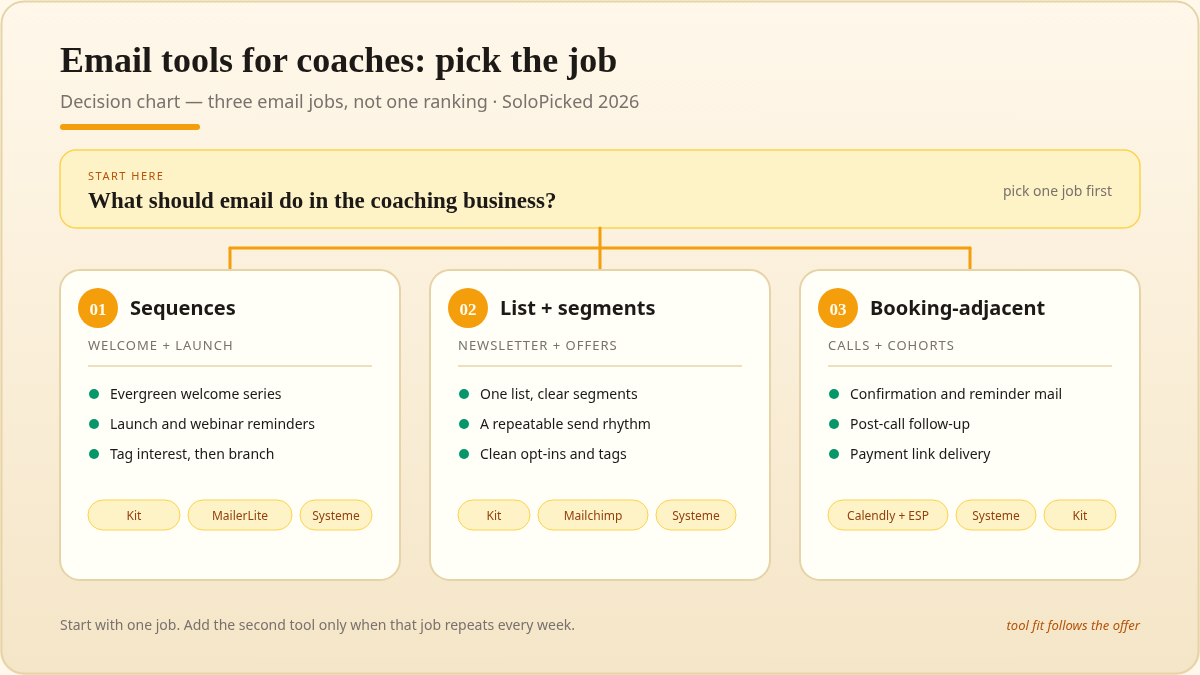
If you coach for a living, your email list is the closest thing you have to a client pipeline you actually own. Social platforms change reach rules overnight. A list does not. What changes instead is which platform you trust to deliver your welcome sequence, your newsletter, your cohort announcements, and the checkout links that follow them.
That is the real decision in front of you — not "which email tool is best," but "which email tool fits the way a coaching business sells." A solo coach running one evergreen offer needs something very different from a coach with a team, a membership, a podcast, and three funnels running at once. If you are still on a $0 budget, our free email marketing tools breakpoint guide covers where the free tiers of Kit, Systeme.io and MailerLite stop working.
Affiliate disclosure: Some links on this page may become affiliate links, meaning SoloPicked could earn a commission if you sign up through them — at no extra cost to you. Nothing on this page is a paid placement, and no vendor has reviewed or approved this comparison before publication. Read our full affiliate disclosure for details.
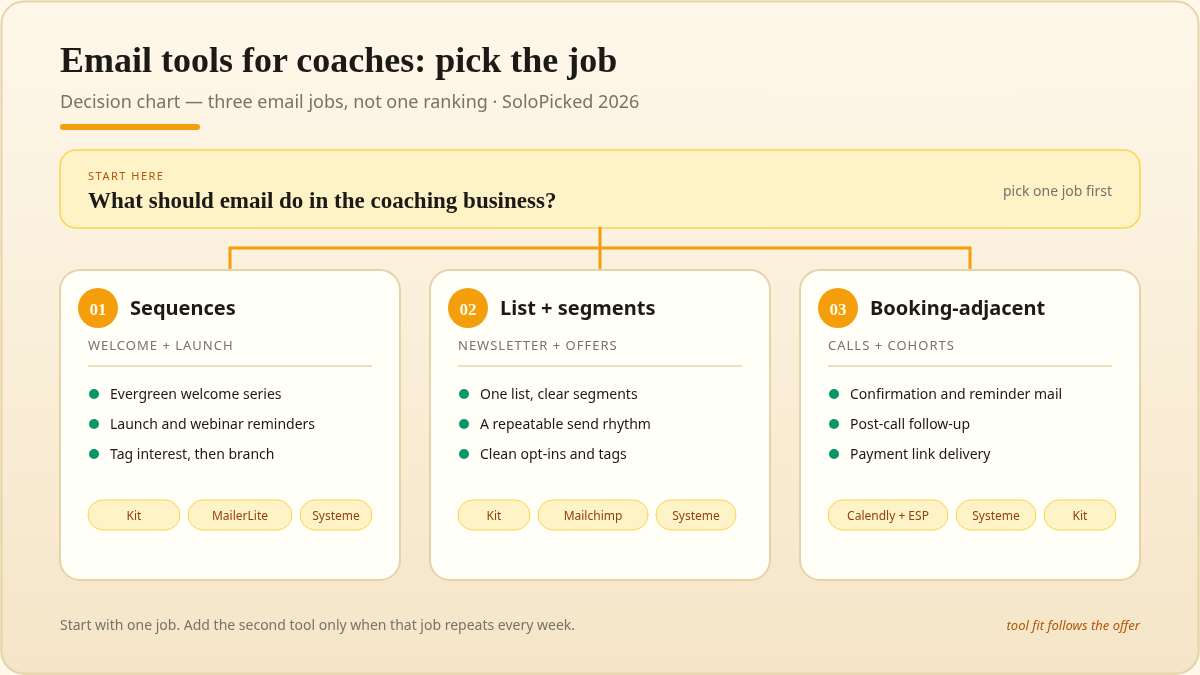
Illustrated chart (warm amber / cream). Not vendor UI.
How this guide was researched
This is an editorial research piece, not a hands-on lab test. We did not run a paid account on every platform for six months to "stress test" deliverability, and we are not going to pretend we did. Recommendations here are based on publicly available feature documentation, published pricing pages, changelogs, help-center articles, and the workflows that come up repeatedly in coaching businesses: lead magnet delivery, nurture sequences, launch emails, evergreen webinar reminders, and low-ticket product sales.
Two practical consequences of that method:
- Pricing is a signal, not a guarantee. Every figure below is an approximate range observed on vendor pricing pages at the time of writing. Email platforms reprice constantly, usually by subscriber tier, send volume, or feature gating. Always confirm on the vendor's own page before you budget.
- Feature lists lie by omission. Almost every tool claims "automation" and "landing pages." The useful question is whether the automation is logic-based or just a timed sequence, and whether the landing pages are good enough to ship without a separate builder.
Where a claim is a judgement rather than a documented fact, we say so.
What coaches actually need from an email platform
Before comparing tools, it helps to be honest about the job. Most coaching businesses need five things, in roughly this order of importance:
- Reliable inbox delivery on a clean sending domain.
- Simple automation — welcome sequences, tag-based branching, and "if they clicked the sales email, don't send the reminder."
- A form or landing page for lead magnets that does not require a designer.
- Some way to take money — a checkout link, a payment integration, or a native product page.
- Readable subscriber management — tags and segments you can reason about at 11pm during a launch.
Here is the criteria table we used to weigh each platform:
| Buying criterion | Why it matters for a coach | What "good" looks like |
|---|---|---|
| Deliverability & sender reputation | Launch emails are worthless if they land in Promotions | Shared IP with strong reputation management, or dedicated IP on higher tiers; easy domain authentication |
| Automation model | Coaching funnels branch on behavior, not just time | Visual builder with conditional paths, tag triggers, and click-based logic |
| Tagging & segmentation | One list, many offers — you must not mail the wrong people | Unlimited tags, saved segments, exclusion rules on broadcasts |
| Forms & landing pages | Lead magnets are the top of every coaching funnel | Native builder, mobile responsive, no separate subscription required |
| Commerce | Low-ticket offers, workshops, paid newsletters | Native checkout or clean Stripe/ThriveCart integration |
| List-growth mechanics | Referrals, recommendations, creator network effects | Built-in recommendation or referral features |
| Price curve at scale | Coaching lists grow fast during a launch | Predictable cost per 1,000 subscribers, no punishing jump at 2,500 |
| Migration friction | Switching mid-year is painful | CSV import with tags, custom field mapping, subscriber scoring |
| Support quality | You are not a developer | Human support on paid plans, documented escalation path |
Kit (formerly ConvertKit)
Kit is the tool most creator-economy coaches end up on first, and the reputation is earned on two specific things: a creator-friendly automation builder and a recommendation network that actually sends subscribers to other creators.
Where Kit is strong
- Visual automation builder. Sequences are genuinely readable — triggers on tag applied, form signup, link clicked, or purchase, with conditional branches. For a coach running a launch, the ability to branch on "clicked the sales page but did not buy" is the difference between a helpful follow-up and spam.
- Tagging as the core data model. Kit treats tags as the primary way to organize people, and broadcasts support exclusions cleanly. If your brain works in "who should not get this email," Kit matches it.
- Landing pages and forms are plain but ship-ready. You will not win design awards, but a lead magnet page built in ten minutes is not a bottleneck.
- Creator Network recommendations are a real growth channel, not a gimmick — subscribers see suggestions from other creators at confirmation, and reciprocity is optional but common.
- Commerce is native-ish. Kit sells digital products and paid newsletters directly, and integrates with Stripe, ThriveCart, and most course platforms without gymnastics.
Where Kit is weaker
- Email design is utilitarian. If your brand depends on heavily designed HTML newsletters, Kit's editor will feel constrained compared to Mailchimp.
- No true CRM. There is no pipeline, no deal stage, no client notes. Coaching businesses that want to track a discovery call inside the same tool will need something else.
- Pricing steps up with subscriber count, so a big give-away that doubles your list also doubles your bill.
Pricing signal (approximate, verify before buying): Kit has historically offered a free tier for a limited subscriber count with reduced feature access, then a Newsletter/Creator tier in the low-to-mid double digits per month, and a Creator Pro tier in the higher double digits that unlocks advanced automation and reporting. Costs scale with subscriber count. Treat any specific dollar figure you see in a blog post — including this one — as a snapshot, not a quote.
Best fit: Coaches who sell courses, cohorts, or paid newsletters; anyone whose funnel logic is conditional; creators who want list-growth mechanics built in.
Systeme.io
Systeme.io is the "everything" option. It bundles email marketing, funnels, landing pages, a course builder, an affiliate program manager, and a checkout in one account. For a coach who is tired of paying for five subscriptions, that consolidation is the entire pitch.
Where Systeme.io is strong
- Genuinely all-in-one. You can build a funnel, host a course, run an affiliate program for your coaching offer, and send the emails — same login, same contact database.
- Unlimited emails on paid plans. Unlike most competitors that meter sends, Systeme.io's paid tiers generally do not charge per email, which matters if you mail a large list frequently.
- Aggressive entry pricing. The free tier is usable for testing the workflow, and paid tiers sit in the low-to-mid double digits. Compared to stitching together an email tool plus a funnel builder plus a course platform, the math is compelling.
- Affiliate program management is built in, which is rare and valuable if you plan to let clients or partners promote your program.
Where Systeme.io is weaker
- Interface density. The tool is powerful and the UI knows it. Expect a learning curve, and expect to consult documentation for non-obvious flows.
- Email deliverability is a shared-reputation game. Systeme.io's sending infrastructure is fine for most coaches, but it is not the boutique deliverability experience some creator-first platforms market. Authenticate your domain early.
- Design ceiling. Templates are functional rather than refined. If brand polish is a priority, you will be fighting the defaults.
- Advanced segmentation is less elegant than Kit's tag-first model. It works, but the mental model takes longer to internalize.
Pricing signal (approximate, verify before buying): A free plan with limited contacts and funnels, a Startup tier around the high twenties per month, a Growth tier in the forties, and an Unlimited tier near one hundred. Annual billing typically discounts meaningfully. Contact limits and funnel limits differ by tier — check those, not just the headline price.
Best fit: Coaches launching their first paid program who want one subscription instead of four; anyone running an affiliate-driven offer; budget-conscious operators who mail often.
Mailchimp
Mailchimp is the default, and defaults exist for a reason: almost every integration you already use — Squarespace, Shopify, Calendly, Zapier, your CRM — has a first-party Mailchimp connector. If your coaching business runs on other software, Mailchimp is the tool that will not fight you.
Where Mailchimp is strong
- Ecosystem and integrations. This is the widest moat in the category. Whatever your scheduling, checkout, or course tool is, it probably talks to Mailchimp natively.
- Email design. The drag-and-drop builder remains the most flexible in this comparison for genuinely designed newsletters, with a large template library and solid mobile preview.
- Reporting and A/B testing are more mature than what creator-first tools offer, especially on mid and upper tiers.
- Brand recognition. For corporate coaching clients or B2B engagements, "we use Mailchimp" raises fewer procurement eyebrows than a niche creator platform.
Where Mailchimp is weaker
- The automation builder is less intuitive than Kit's for branching, behavior-based coaching funnels. It can do a great deal, but the path from idea to live automation is longer.
- Pricing has become less predictable. Plan structures, contact tiers, and send limits have shifted repeatedly. Small lists can end up paying more than they expect, and free-tier limits are tighter than they used to be.
- Tags exist but are not the center of the model, so exclusion-based sending requires more deliberate setup than in Kit.
- Commerce for coaching products is weaker — no native course hosting, and paid-newsletter support is not a core strength.
Pricing signal (approximate, verify before buying): A free tier with a low contact cap and monthly send limit; Essentials in the low-to-mid double digits for small lists; Standard in the twenties to fifties depending on contact count; Premium well into the hundreds for large accounts. Prices scale with contacts and, on some plans, with send volume. Confirm current structure on Mailchimp's pricing page — this is the vendor whose pricing changes most often in this list.
Best fit: Coaches embedded in an existing software stack, corporate-adjacent coaches, and anyone whose priority is designed newsletters plus integrations over funnel logic.
Runners-up worth a look
Beehiiv
Beehiiv started as a newsletter platform and grew into a credible email marketing tool. Its differentiators are a strong referral program, native ad and sponsorship infrastructure, and a publishing-first editor. For a coach whose main asset is a weekly newsletter — and who might want to monetize it beyond their own offers — Beehiiv is the most interesting alternative to Kit.
The trade-off: funnels and course commerce are less developed than Kit's or Systeme.io's, so you will likely pair it with a checkout tool. Its free tier is generous for early lists, with paid tiers scaling from roughly the thirties into the low hundreds per month depending on subscriber count and features. Coaching funnels are not its center of gravity; coaching newsletters are.
Flodesk
Flodesk's pitch is flat-rate pricing and beautiful email design. Historically it has charged a single monthly fee regardless of subscriber count, which is a genuinely different economic model — and for a coach with a large but low-monetization list, it can be dramatically cheaper than per-subscriber tools. The templates are the most aesthetically polished in this comparison.
The trade-off: automation is simpler than Kit's, native commerce is limited, and the flat rate is only a bargain if your list is big. Confirm current pricing, since flat-rate models get revised. Flodesk suits coaches whose brand is visual — wellness, interior design, styling, photography — and whose funnels are short.
Comparison table
| Tool | Automation depth | Landing pages & forms | Native commerce | Design quality | Pricing shape | Best for |
|---|---|---|---|---|---|---|
| Kit | High — conditional, tag-based | Good, plain but usable | Digital products, paid newsletters | Utilitarian | Scales with subscribers | Course & cohort coaches, conditional funnels |
| Systeme.io | Medium — solid, less elegant | Strong, funnel-oriented | Yes, plus affiliate management | Functional | Flat-ish tiers, unlimited emails | First paid program, all-in-one, budget |
| Mailchimp | Medium — capable, less intuitive | Good | Weak for coaching offers | Best-in-class editor | Scales with contacts and sends, changes often | Existing stacks, corporate clients |
| Beehiiv | Medium | Good | Limited | Strong for newsletters | Scales with subscribers | Newsletter-first coaches, sponsorship |
| Flodesk | Low–medium | Good | Limited | Most polished | Flat rate, verify current | Visual brands, large low-ticket lists |
A note on that table: "medium" automation is not a criticism. Most coaching funnels need three or four branching sequences, not a workflow engine. The failure mode we see most often is a coach buying enterprise-grade automation and never building the second sequence.
Who should pick what
- Pick Kit if you sell courses, cohorts, or a paid newsletter, and your follow-up depends on what people click. The tag-first model and conditional automation are the closest match to launch-driven coaching.
- Pick Systeme.io if you are launching your first paid program and want one login for funnels, email, checkout, and course delivery — and you mail often enough that per-email pricing would sting.
- Pick Mailchimp if your coaching business already runs on a stack of tools that expect Mailchimp, or if designed newsletters and client-facing brand polish outrank funnel logic.
- Pick Beehiiv if the newsletter is the product and you want referral mechanics and sponsorship infrastructure built in.
- Pick Flodesk if your brand is visually driven, your list is large, and your sequences are short and simple.
Two honest edge cases. If you need a real sales pipeline and client records, none of these five is a CRM — pair your email tool with a lightweight CRM rather than forcing one to do both. And if you are pre-revenue with fewer than a few hundred subscribers, the correct answer is usually the free tier of the tool whose interface you find least annoying, because switching costs at that size are near zero.
FAQ
Is Kit the same as ConvertKit? Yes. ConvertKit rebranded to Kit, and the product is the same one creators have used for years. Existing documentation, integrations, and migration guides still reference both names, so search results can be confusing — but you are not choosing between two tools.
Do I need a separate landing page builder if I use these tools? Usually not, for lead magnets. Kit, Systeme.io, Mailchimp, Beehiiv, and Flodesk all include form and landing page builders adequate for a PDF giveaway or webinar registration. You would only add a dedicated page builder if you want advanced design control, A/B testing on page layouts, or long-form sales pages that live outside email.
Which of these is best for a small list under 1,000 subscribers? At that size, cost differences are negligible and every option has a workable free or low tier. Optimize for the funnel you intend to build rather than the price: if you plan conditional sequences, start on Kit or Systeme.io so you do not have to migrate later. Migration at 1,000 subscribers is tedious; at 10,000 it is a project.
How much does email marketing software cost for coaches? Realistically, expect somewhere between roughly $0 and $60 per month for a list in the low thousands, depending on tool and tier, with costs rising as your list and sending volume grow. Flat-rate tools can beat per-subscriber tools on large lists and lose badly on small ones. All figures in this guide are approximate — verify on each vendor's pricing page, because these numbers move.
Is Mailchimp still worth it in 2026? Yes, for specific jobs: integrations, designed newsletters, and organizations that expect a familiar brand. It is a weaker choice than Kit for behavior-based coaching funnels, and its pricing has become harder to predict. If neither integrations nor design is your priority, the creator-focused tools in this list usually fit coaching workflows better.
Can I migrate between these tools later? Yes, and all five support CSV import and export with tags and custom fields. The friction is not the contacts — it is rebuilding automations, forms, and landing pages, plus re-authenticating your sending domain. Budget a weekend, and keep your old tool active for a two-week overlap so in-flight sequences do not break.
What about deliverability — does the tool actually matter? It matters less than your own sending behavior. Authenticate your domain with SPF, DKIM, and DMARC; send consistently rather than in bursts after months of silence; and clean inactive subscribers. A well-configured account on any of these platforms will outperform a neglected account on the "best" one.
Final take
For most coaches selling a course, cohort, or paid newsletter, Kit is the strongest default because its automation model matches how coaching funnels actually branch. Systeme.io wins on cost-per-feature for a first paid program. Mailchimp remains the pragmatic choice when your software stack effectively makes the decision for you.
If you are deciding this week, the useful next step is not another comparison article — it is picking the free or entry tier of one tool and building your welcome sequence. A mediocre platform with three working automations beats a perfect platform with a blank dashboard.
Prices, plan structures, and feature availability referenced in this guide are approximate and change frequently. Confirm current details on each vendor's official pricing page. SoloPicked does not provide hands-on lab testing for this article; recommendations are based on public documentation and common coaching workflows. See our affiliate disclosure.